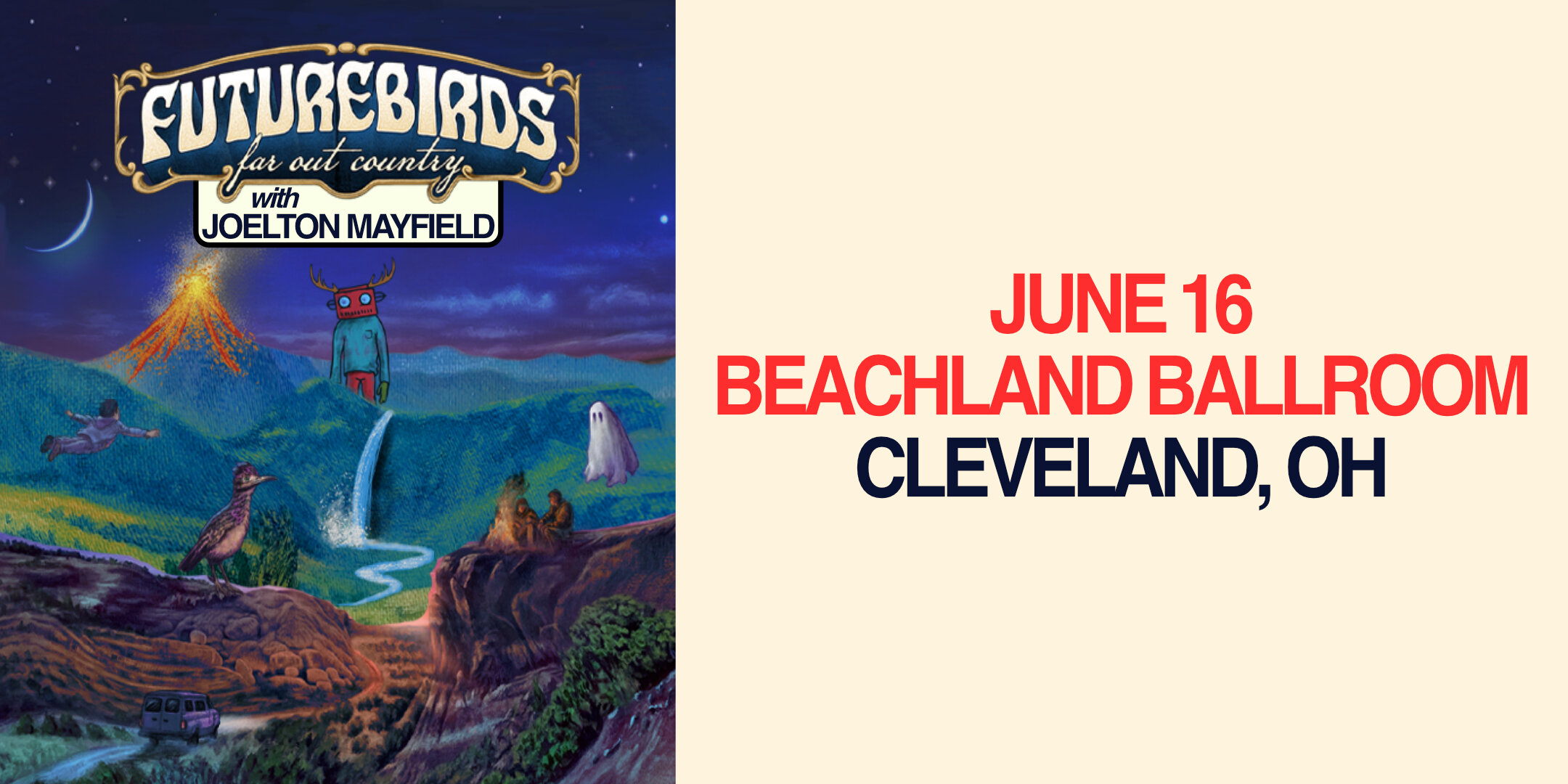
June 16, 2026
Doors: 7:00 PM - Show: 8:00 PM
All Ages
Far Out Country Tour
Futurebirds
with Joelton Mayfield
Beachland Ballroom
15711 Waterloo Road, Cleveland, OH, 44110
Date & Time
Tuesday, June 16, 2026
8:00 PM
Location
Beachland Ballroom
15711 Waterloo Road, Cleveland, OH, 44110
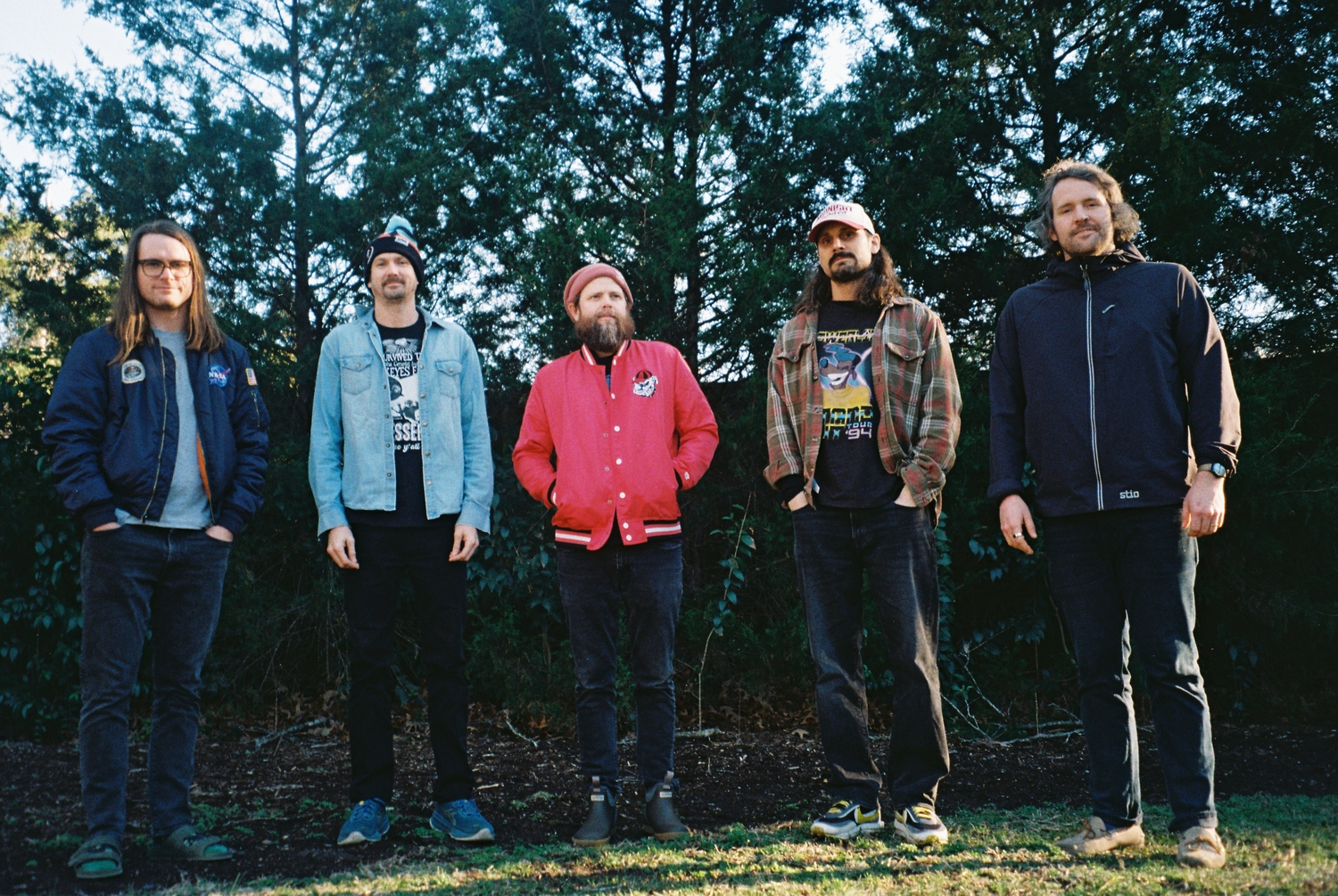
"I'm movin' on," Daniel Womack sings during the first minute of Easy Company, an album that finds Futurebirds — once the best-kept secret of Athens, GA's music scene, now a beloved act on a national scale — back in the driver's seat, speeding together toward some new horizon.
Momentum. Evolution. Expansion. Those are important traits for a critically-acclaimed group that recently celebrated its 15-year anniversary. "When you've been a band for as long as we have, there's a lot of moving on," says Thomas Johnson. "We just keep going, because that's how you keep things fresh. That's how you keep the spark." By matching the sharply-written songs of three distinct frontmen with a progressive mix of rock & roll, electrified folk, and cosmic American roots music, Futurebirds have built an audience that's as wide as the band's own sound. With Easy Company, Futurebirds' fifth studio album, that sound reaches a new peak.
Featuring four songs apiece from singer/songwriters Womack, Johnson, and Carter King, Easy Company feels like a celebration of the tight-knit bonds that have held Futurebirds aloft since 2008. Back then, the guys were college students at the University of Georgia, building a buzz around town with shows at fraternity houses and local bars. Years later, they've become headliners at bucket-list venues like The Ryman and The Fillmore, collaborating with fellow genre benders like My Morning Jacket's Carl Broemel along the way. They team up with new partners on Easy Company, which was recorded with producer Brad Cook in the border town of Tornillo, TX. The guest list includes Waxahatchee's Katie Crutchfield, who trades verses with King on the album's title track, and Drive-By Truckers co-founder Patterson, who delivers a spoken-word monologue during "Soft Drugs." A brass section even makes a brief appearance. The result is a bold blend of old and new, delivered by a band of brothers who've never sounded so invigorated. Easy company, indeed.
"We've made a concerted effort to challenge ourselves, always finding new angles to look at this thing we've been doing for more than 15 years," says King. "What hasn't changed is the core of this band. We still have three songwriters. We still have our original bass player, Brannen Miles. When you come this far together, your walls come down and you realize that these friends know exactly who you are, and you know exactly who they are, and it's such a relief when everyone can just be themselves. It's great company to be in, and it's so much better for the art."
Futurebirds kickstarted Easy Company's creation with a week's worth of live-in-the-studio performances. For a group of road warriors who'd already logged thousands of hours onstage, this was an opportunity to capture the sheer energy of a Futurebirds show — the same show that prompted Rolling Stone to dub the band "the most captivating rock act touring today" — on tape. "People sometimes see us live and say, 'It sounds so energetic, big, and full onstage, but some of your earlier records don't really capture that,'" King explains. "That was something we talked to Brad Cook about. We wanted to find that live magic in the recording studio. We wanted to move fast and stay in the moment."
The results speak for themselves. Praised by USA Today for "mixing Neil & Crazy Horse with My Morning Jacket" on their previous records, Futurebirds defy comparisons altogether with Easy Company. "Colorados" pays tribute to the Centennial State with sunny vocal harmonies and Kiffy Myers's searing pedal steel. "Bloom" begins with a solitary acoustic guitar, then gives way to thick, reverb-soaked soundscapes. Drummer Tom Myers take a bow during "Solitaires," a song driven forward by deep, Deadhead-worthy grooves, while keyboardist Spencer Thomas adds gauzy atmosphere to tracks like "Feel Less Bad." It's easy to imagine those songs becoming highlights of the band's concerts, joining audience favorites like "Trippin'" as setlist staples, but Easy Company wears its studio-album status proudly. It also marks the first time Futurebirds have handed over the reins to an outside producer. Free to focus exclusively on the music itself, they've never sounded so dynamic. The loudest moments reach a new peak of big-budget crescendo. The softer moments evoke cozy campfires and front-porch guitar pulls. Brad Cook captures the full range of those performances, but it's the bandmates themselves who make Easy Company sound, well, easy.
"We've never thought of ourselves as one particular kind of band," says Womack. "That's important for longevity, because we're always recreating ourselves and finding ourselves all over again. I don't think we're done with that process. We're always ready for more."
For Futurebirds, the road goes on forever. Easy Company is the latest stop on a journey that's still unfolding, winding its own path through American rock & roll, giving Futurebirds and the grassroots community they've created — the Birdfam — a new place to land.
Website • Instagram • Spotify • Facebook • Twitter • Youtube • TikTok

By the winter of 2021, Joelton Mayfield had done nearly a decade of work to prepare his debut LP, Crowd Pleaser. As a teenager, he’d toiled for years as the music director of his Texas church, despite extreme doubts about Christianity’s role in his life and his role in Christian life. He’d then shipped off to Nashville, hoping to earn a music business degree in the city where they seem to be factory-made. He’d instead switched to English, studied the more mature songwriters around him, joined a series of college bands, and drifted into the edges of the city’s indie rock and alt-country enclaves, building a patchwork of players he trusted.
And that February, he’d driven two trailers and several carloads of gear to a farm near Alabama’s Mobile Bay, turning the family barn of a bandmate friend into an ad hoc studio. He’d trucked a Hammond organ from Nashville and his grandmother’s century-old vibraphone from Texas, even buying a stack of area rugs to absorb the sound bouncing from the barn’s concrete floors. And then, just days before Mayfield was set to make his first full-length testimonial, the love of his young life—and the person set to co-produce the album, no less—dumped him.
The three weeks that followed were among the best and worst times of his life. Mayfield substituted a pack of cigarettes a day and too much booze for sleep, teetering on the edge of a breakdown. He was moody, distraught, and distracted, caught in a nightmare. But this was also his dream, being surrounded by musical friends from Texas and Nashville in a barn-turned-studio that was more practical and interesting than he could have imagined, singing songs about trauma and hypocrisy and pain and disappointment that had, in a very real way, already saved his life.
So Mayfield and a band that sometimes numbered nearly a dozen rendered these 10 songs with radical urgency, the bummer feelings that had first led to them reanimated by sudden rejection. Mayfield clung to his own words, like a life preserver or guardrail or any piece of art that simply reminds someone that this world can always change for worse but especially better. Indebted to traditions of incisive Southern storytellers and country-rock bands interested in upending their forms, Crowd Pleaser squares up to the difficulties and betrayals of Mayfield’s first quarter-century and makes the absolute most of them—10 compelling affirmations for the rest of us.
Raised outside of a small central Texas city, surrounded by open farm fields and dirt roads, Mayfield was a “miracle baby,” the child his parents never truly expected after decades of trying. His family was religious and musical, two disciplines forever intertwined in their lives, both at home and at their Pentecostal church. As a kid, Mayfield won awards in the Royal Rangers, a conservative Boy Scouts alternative, for his ability to recite Bible verses; as a teenager, he began leading Wednesday night worship services for people much older than him and eventually even helming the church’s music ministry. Outside of oil-slick Contemporary Christian Music, he heard only some classic country, scant Texas blues, and the Gaithers, a family institution that was in turn a family favorite. There was no household internet, and television was censored by a draconian device called TV Guardian.
Fissures slowly grew between Mayfield and the church, Mayfield and family. He heard the words about treating people kindly but then saw how others who were not straight and white were handled by the so-called faithful. He felt exploited, too, his interest in and predisposition for music used as (largely) unpaid labor. These feelings coincided with his late discovery of songs beyond his faith. Dylan’s “Knockin’ on Heaven’s Door” exploded his idea of what a tune could accomplish, as did a web of relatively outsider songwriters—Sufjan Stevens, David Bazan, Jeff Tweedy. He began writing for himself, not only slowly finding his voice but a map of what he believed and rejected. He fled Texas for Tennessee, intuitively knowing there was more to discover than his hometown cloister of culture.
Crowd Pleaser documents the widening chasm between Mayfield, the sheltered Texas kid, and Mayfield, the burgeoning songwriter indulging in all the music, movies, relationships, books and conversations that came with leaving his sheltered early life. His sense of the bigotry, misogyny, and myopia he’d left behind sharpened, too. These songs are a map of an unraveling and the concomitant reformation, as he sorts through hypocrisies, doubts, and disappointments and does his best to make sense of them. Throughout Crowd Pleaser, Mayfield returns to the line “God’s children never grow up.” It’s as if he’s finally admitting not only that he was cast out of the garden long ago but also that there may never have been a garden at all, that you have to move along to find out.
Penned in three sections, the pulsing “Speechwriter” wades through the lies we slowly learn we’ve been living with, from the way the government (no matter who has held power during the last 250 years) fronts about holding your best interests in its candid little capitalist heart to the promise of privilege that can still leave one rotten to the core. “How can I convince you anything I’ve ever felt is worth grieving?” he asks in one stinging line. That same unease permeates “The Shore,” where everything we think we know and love seems only like a cover for a collapse that will happen any minute. “Is this the future we always dreamed of?” Mayfield sings, his voice and the band behind him so calm and cool that they seem to be teasing us for the devastation we have yet to detect.
The woes, mind you, aren’t all so existential. If you hear some familiar lines in “Turpentine (You Know the One),” yes, Mayfield borrowed bits from Wilco and the Mountain Goats on one of the oldest songs included here, meant to illuminate both the perpetual failures of the music industry but also the miraculous way people keep making and sharing songs, anyway, because they remain so very powerful and potentially resonant. Wilco’s Late Greats failed, as did the Mountain Goats’ Best Ever Death Metal Band Out of Denton. Instead, in Mayfield’s vision, we get stuck with the bullshit band on Spirit 105.9 that is “everything you hate about everything you wish you liked.” And still, we create. Cruelty comes in many forms, including rock radio.
Many of Crowd Pleaser’s songs scan as steadfast alt-country, Mayfield digging into a bedrock of so-called Americana like a strata of sediment simply waiting to be discovered. As important, though, are the vivid signs here that he is part of a Gen Z cadre for whom Wilco’s Yankee Hotel Foxtrot and A Ghost Is Born, Pavement’s Slanted and Enchanted, and Neil Young’s Harvest are part of the same firmament, not aberrations in its architecture.
You can hear it immediately in opener “Red Beam,” an apocalyptic vision of every new morning where the growing sound swallows you like a blazing Southern sunrise. Cut by noise and samples and built with a nonlinear structure that allows Mayfield to wrestle with the biggest questions of our existence without pretending to have tidy conclusions, it is a theme song for stumbling into the unknown, blinking hard, and moving forward, anyway. You can hear it in “Blame,” too, a chronicle of being let down and left out, even when one’s desires are as simple as “a highway exit/a checkout before 11.” Sheets of drone radiate beneath the electric surges of the chorus, while bits of dissonant strings circle the verses like the thoughts of a brain addled by its own overdrive. And what of the rumbles beneath and glows around “Jacob Dreamed a Staircase,” a beautiful hymn about being deserted by faith, where the sounds sigh and moan and growl like heavenly taunts? Crowd Pleaser is only the first full statement from a singer-songwriter invested in the future of his chosen field.
In 2024, a year before Crowd Pleaser was even ready for release, Mayfield opened several shows for two heroes—John Darnielle, of the aforementioned Mountain Goats, and John Moreland. Both have used songwriting to stare into personal voids, to stand at the edge of some never-ending abyss and tell the truth about what they’ve seen down there. Mayfield is a new member of that tradition, having put some of the most difficult lessons he’s learned in life to paper and then gathering his friends to help animate them, to turn them into these songs meant to be shared like communion. “God’s children never grow up,” goes that refrain. Yes, some of them just grow into something unexpected: songwriters able to relay the good news that can exist in passing through the hardest of times and emerging on another side, able to sing about it.